
How to Get a Google Autocomplete Suggestion Removed: The 2026 Playbook
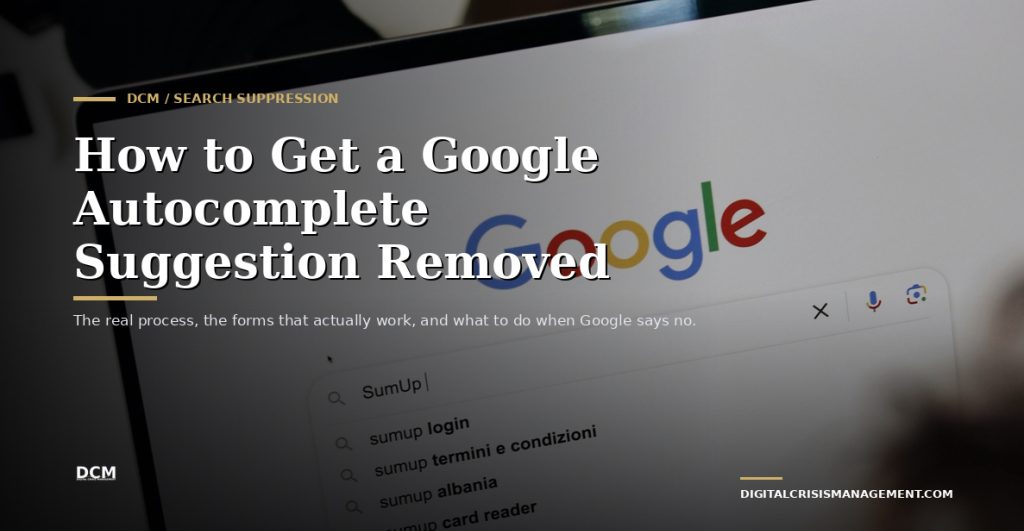
Type your name into Google. Watch what appears under the search bar before you finish typing.
For most people, autocomplete is a convenience. For anyone dealing with a reputation problem, it is one of the loudest signals on the entire internet. A single ugly word — “scam,” “lawsuit,” “fraud,” “arrested,” “divorce,” “cheating,” “fired” — attached to your name in the dropdown is worse than the article that generated it. The article is one result on page one. The autocomplete prediction is a suggestion Google puts in front of every person who starts typing your name, before they have even decided what they were looking for.
Autocomplete does not just reflect what people search. It shapes what they search next. That is why it matters so much, and why removing a bad prediction can move the needle on your reputation faster than almost any other single tactic.
This post is the real playbook we run at Digital Crisis Management when a client asks us to clean up their autocomplete. Not the surface-level “just report it” version. The actual 2026 process, including which of Google’s five policy grounds each type of prediction falls under, what the report form looks like, when to escalate legally, and what to do when Google refuses — which, in our casework, is more than half the time.
What Google Autocomplete Actually Is
Google’s autocomplete predictions — internally still called Suggest, publicly called Autocomplete — are algorithmically generated based on real user searches, trending queries, your location, your search history, and content Google has indexed about the query. Google’s own explainer on how Search autocomplete works is unusually candid about this: the predictions are pulled from live search behavior and then filtered through Google’s policies.
The important part is the filtering. Google does have policies. Predictions can be, and routinely are, removed. But the removal is policy-driven, not complaint-driven. A prediction being embarrassing to you is not a reason Google will remove it. A prediction violating one of five specific policy categories is.
Understanding which category yours falls into is the entire game.
The Five Grounds Google Will Remove an Autocomplete Prediction On
Google’s Autocomplete policies for Search list the specific categories of predictions Google will remove. In plain language, they are:
Sexually explicit predictions. Predictions that suggest sexual acts, nudity, or graphic sexual content associated with a person or business. This is the fastest policy path when it applies. Google removes these reliably and typically within days.
Hateful predictions. Predictions that target people based on race, ethnicity, religion, disability, gender, age, nationality, veteran status, sexual orientation, or gender identity. If the prediction attaches a slur or hateful term to a person or group, this is the policy hook.
Violent predictions. Predictions that promote or depict violence, gore, or threats against a specific person or group. A prediction pairing your name with a threat or with the phrase “how to kill” qualifies.
Dangerous predictions. Predictions that promote dangerous activities that could cause harm — self-harm, dangerous challenges, dangerous “how to” queries. Rare in a reputation context, but relevant if the prediction ties your name to self-harm content.
Harassing predictions. Predictions that attack, insult, threaten, or bully a specific person. This is the broadest and most useful category for reputation cases. A prediction pairing your name with “scammer,” “fraud,” “creep,” or an insult that would clearly be understood as a personal attack often qualifies here. The bar is higher than most people expect, but it is where most successful removals actually land.
There are also two adjacent policies worth knowing.
Personal information. Under Google’s Results about you framework, predictions that expose your home address, phone number, email, government ID, or other sensitive identifiers can be removed even when they do not fit the five categories above.
Legal removal. Predictions that violate applicable law — including defamation judgments, court orders, or intellectual property rulings — go through the Legal Help removal form instead of the standard feedback path.
If your prediction does not fit any of these seven categories, no amount of reporting will get it removed. You need to shift to the suppression tactics we cover later in this post.
The Actual Report Form (And Why Most People Miss It)
Google buries the autocomplete report link on purpose. Here is how to find it and use it correctly in 2026.
Step one. On desktop, run the exact search that triggers the bad prediction. Do not type into the URL bar — type into Google’s search box on google.com. The prediction has to appear in the dropdown for the reporting flow to attach to it.
Step two. Hover over, or on mobile long-press, the specific prediction you want removed. A small “Report inappropriate predictions” link appears at the bottom of the dropdown. That link is the front door to Google’s autocomplete removal review system.
Step three. In the form that opens, select the policy category the prediction violates. This is the most important field. If you pick the wrong category, your report is likely rejected by the first-line reviewer. Pair the prediction with the closest category from the five above.
Step four. In the free-text field, describe why the prediction violates that category in one or two sentences. Do not argue. Do not include emotion. Do not attach a life story. The reviewer has 30 seconds per report. Give them exactly the sentence they need to check the box and move on.
Step five. If you are the target of the prediction, say so plainly and note that you are the person named. If you are reporting on behalf of a client, business, or family member, say that too.
Step six. Submit. Save a timestamped screenshot of the prediction, the report page, and the confirmation. You will need this if you have to escalate.
Google does not send confirmation emails and does not tell you the outcome. You find out by re-running the search a week later. If the prediction is gone, you won. If it is still there, you need to escalate.
When Google Says No: The Escalation Path
Most first-round reports get rejected, silently. In our casework, roughly 40 to 55 percent of autocomplete reports fail on the first submission even when the prediction clearly fits a policy category. The reviewers work fast and default to leaving predictions in place.
Here is the escalation path we run.
Re-submit with a different policy anchor. Many predictions fit more than one category. A prediction pairing a business owner’s name with “scam” can be argued as harassing, and, depending on context, as defamation-adjacent. Try the second-best category on a second submission. Wait at least seven days between attempts.
Layer a legal filing. If the prediction has been the subject of a defamation determination — a takedown letter from counsel, a cease and desist, or, ideally, a court order — file through the Legal Help removal request portal. Google handles those on a separate track from the standard reports. A properly documented legal submission moves faster than most people expect.
Use the Results About You dashboard. If the prediction is tied to personal information exposure, submit through myactivity.google.com/results-about-you. Predictions that surface someone’s phone, address, or email are eligible for removal on personal-information grounds even when the harassment argument fails.
Right to be Forgotten (EU / UK). If the person named lives in the European Union, the United Kingdom, Switzerland, or a jurisdiction with equivalent right-to-be-forgotten protections, the European privacy removal request form is a separate lever. Autocomplete predictions are covered under the EU’s GDPR Article 17 right to erasure and have been the subject of multiple national data-protection authority rulings. The bar in the EU is materially lower than in the United States.
Escalation with documentation. If none of the above works and the prediction is causing measurable harm — lost customers, denied job offers, denied loans — the escalation path we use as a reputation firm involves a formal packet: policy citation, evidence of harm, prior submission timestamps, media context, and, where available, counsel involvement. Google’s Search team does escalate these cases internally when the packet is professional. This is not something a consumer form is designed for. It is where a reputation firm with removal experience earns its fee.
When the Prediction Is Defamatory
If the prediction is factually false and damaging — “John Smith embezzlement” when there was no embezzlement, “Acme Corp Ponzi scheme” when there is no Ponzi scheme — you are in defamation territory, which changes the playbook.
Autocomplete-specific defamation has been litigated in courts around the world. In the United States, Section 230 of the Communications Decency Act has historically shielded Google from liability for user-generated content, and courts have extended that shield to autocomplete predictions in most cases. But defamation judgments against the original source of the false claim — the article, the review, the forum post that drove the prediction — do work. Once the underlying source is removed or de-indexed, the prediction usually decays within weeks because the search behavior that fed it dries up.
Outside the United States, the picture is different. Courts in Germany, France, Italy, Australia, and Japan have all ordered Google to remove autocomplete predictions on defamation grounds in the last decade. If your target lives in one of those jurisdictions, a local judgment is a faster route than any policy report.
For US-based individuals and businesses, our standard defamation-driven autocomplete cleanup is a two-track workflow: kill the source (usually a news article, Ripoff Report thread, or Google review), and file the autocomplete report in parallel with the underlying-source proof. Google’s Search team weights removal reports meaningfully more when the source of the search behavior has already been neutralized. When we combine this with our broader suppression strategy for negative search results, the prediction typically drops out of the dropdown within one to two crawl cycles.
When Google Refuses: The Suppression Route
If your prediction does not fit a policy category and is not defamatory in a provable way — “John Smith divorce,” “Acme Corp layoffs,” “Jane Doe departure” — Google will not remove it. Full stop. This is where most people get stuck and where most cheap ORM firms give up.
Autocomplete is fed by real search volume. It responds to what people are actually typing. The suppression play is to drown the bad query in bigger, cleaner, positive queries associated with your name or brand.
The tactics that actually work in 2026:
Positive query seeding. Publishing content and campaigns that generate real, measurable search volume for your name paired with neutral or positive modifiers. “John Smith speaker,” “John Smith author,” “John Smith interview,” “John Smith podcast.” Google’s autocomplete rank-orders predictions by search velocity. A neutral prediction with three times the volume of the negative prediction pushes the negative one below the visible fold, then off the list entirely.
Brand SERP shaping. Your first-page Google results and your autocomplete predictions are correlated. When a prediction is tied to a specific negative article, killing or suppressing the article typically kills the prediction on a delay. Our suppression service attacks both surfaces simultaneously.
AI answer engine alignment. Autocomplete is one signal Google increasingly uses to inform its AI Overviews and Search Generative Experience answers. A cleaner autocomplete profile leads to cleaner AI answers about you, which is why our AI search reputation management service treats autocomplete as part of the same surface, not a separate problem.
Media production. New coverage from mid- and high-authority outlets — the kind of coverage we place as part of our executive and individual reputation program — generates its own search behavior. A well-placed interview in a trade publication routinely produces enough branded search volume to displace a legacy negative prediction inside a quarter.
The timeline for suppression-based autocomplete cleanup is typically 60 to 120 days from campaign launch, versus one to two weeks for a successful policy removal. It is slower, but it is the only durable route when the prediction is not policy-violating.
What Doesn’t Work
To save you time and money, here are the tactics that circulate on the internet and do not actually work in 2026.
Botting positive searches. Google’s Search quality guidelines and spam policies both flag artificial query inflation. Real search volume works. Fake search volume gets detected and either ignored or penalized.
Asking friends to search your name. The volume is too small, too geographically clustered, and too pattern-recognizable to move a prediction that is fed by hundreds of thousands of real searches.
Filing a police report. Unless there is an underlying crime — extortion, stalking, criminal harassment — this does not create leverage over Google.
Sending Google a demand letter without a legal predicate. Google’s legal team sees hundreds a week. Without a court order, a defamation judgment, or a clear policy citation, the response is a form rejection.
Buying a course on autocomplete manipulation. Every course sold in this category is either the exact policy report process we describe above, or a version of botted searches that does not work.
The DCM Approach
At Digital Crisis Management, we treat autocomplete as one of five reputation surfaces we manage in an integrated engagement: main Google results, autocomplete, People Also Ask, AI answer engines, and Google Business Profile / reviews. A negative prediction almost never exists in isolation. It is usually the visible tip of a broader problem — an article we can address through content removal, a review pattern we can address through business reputation management, or a personal-information exposure we can address through our privacy and personal information removal service.
Our engagements come with written outcome-based guarantees. If we quote you a 90-day timeline to clear a specific prediction, that timeline is the commitment, not a suggestion. If we do not hit the outcome we contracted to deliver, you do not pay for the outcome we did not deliver. That is unusual in the reputation industry and, in our view, the only fair way to sell a service tied to a search algorithm neither of us controls.
Talk to Us
If you have an autocomplete prediction attached to your name or your business that is costing you customers, deals, hires, or peace of mind, the first step is a free consultation. We will tell you which of the seven policy hooks your prediction fits, what the realistic removal path looks like, what it will cost, and what timeline we will guarantee.
You can reach us at digitalcrisismanagement.com/contact.
The prediction has been there long enough. Let’s take it down.
Last updated: September 2026. Digital Crisis Management is a US-based reputation and crisis management firm serving individuals, executives, and businesses. All engagements include written outcome-based guarantees.