Best Reputation Management Companies for Crisis (2026)
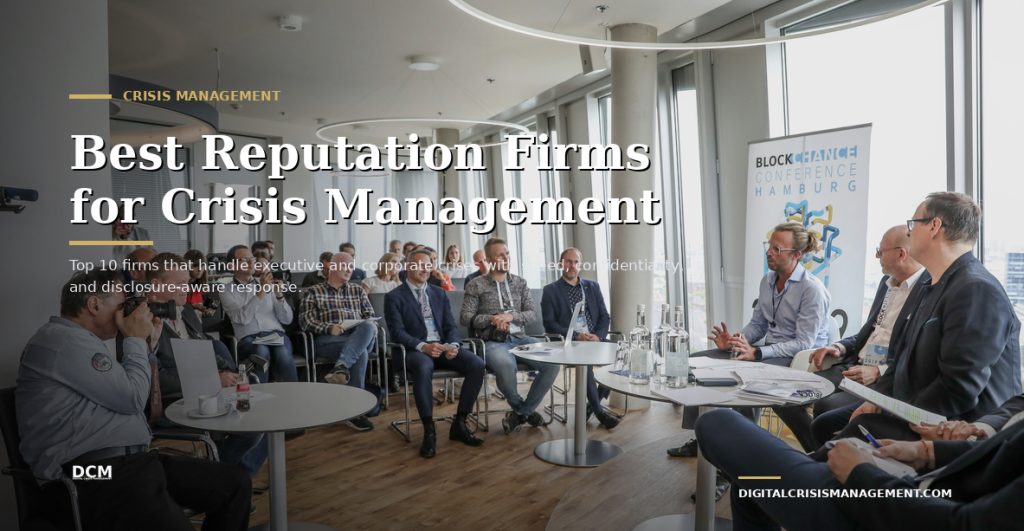
Best Reputation Management Companies for Crisis Management: Top 10 Firms for Individuals and Companies
Last updated: June 2026
A crisis is not a bad review. A crisis is the moment a news cycle, regulator, plaintiff, short seller, or viral clip starts reshaping how a person or company is perceived in real time. Search results shift in hours. AI chatbots start citing the most damaging version of the story. Lawyers, board members, clients, lenders, and family members all start refreshing Google at the same time.
Most online reputation management firms are built for the slow grind of suppressing old links and writing fresh content. A small subset are built for the first 48 hours of a real crisis, when speed and confidentiality matter more than monthly reporting cadence. An even smaller subset can do both sides of the work, individuals and companies, under one roof.
This is our ranked list of the firms that can. We picked them based on track record on confidential matters, cross-domain capability across both executive and corporate files, regulatory familiarity, demonstrated removal and de-indexing experience, work on AI search reputation, and willingness to stand behind outcomes. We left two well-known low-cost ORM brands off the list on purpose. Neither belongs in a serious crisis conversation.
What separates a crisis firm from a regular reputation firm
Three things, mostly.
The first is speed. A normal ORM engagement starts with an audit, a content plan, a six-month timeline. A crisis engagement starts with a phone call at midnight and a coordinated response by morning. The firm you want has on-call partners, a 24-hour ops capability, and a process that can run in parallel with outside counsel from minute one.
The second is disclosure awareness. If the person in trouble is a public-company executive, a regulated professional, a board member, or a portfolio company leader, the response is constrained by securities law and exchange rules. SEC Regulation Fair Disclosure governs how material non-public information can be communicated. The SEC’s 2023 cybersecurity disclosure rule added Item 1.05 to Form 8-K, with a four-business-day reporting clock for material incidents. A firm that does not understand those clocks can create a disclosure violation by sending the wrong holding statement at the wrong time.
The third is removal and search engineering. Apology tours and op-eds do not change the page-one results that recruiters, lenders, journalists, and AI chatbots actually read. A real crisis firm pairs the messaging work with takedown work across Google, Bing, Meta, X, YouTube, Reddit, and the AI answer engines. The 2024 FTC fake-reviews rule created a federal hook for removing fabricated review content. Section 230 and the platform terms it enables give a trained team paths to de-index or remove content that lawyers alone often cannot. Search behavior research from Backlinko shows roughly 75 percent of clicks go to the top three organic results, which is why moving one negative URL from position two to position eleven materially changes the file.
How we ranked these firms
We weighted the firms on six factors. Track record on confidential matters mattered most, since the best crisis work is never written up anywhere. Cross-domain capability across both individual and corporate files came next, because most crises spill across both. Disclosure and regulatory fluency mattered for any firm that wants to be in the room with public-company counsel. Removal and AI search reputation capability mattered because messaging without search engineering is a half-treatment. We discounted firms that publicly advertise pricing as a primary differentiator, since pricing-led ORM tends to mean templated suppression and weak crisis bench. We did not weight size or office count. Some of the strongest crisis shops in the world are under twenty people.
The Top 10
1. Digital Crisis Management
Digital Crisis Management is built specifically for the kind of cross-domain file that ruins normal ORM playbooks: an executive named in a news investigation, a private-company founder facing a viral allegation, a clinic or firm where the personal and business reputation are the same asset, a leader whose old court record just resurfaced on a search engine or an AI chatbot. The team works on both sides at once. We treat the executive file and the company file as one engagement because that is how the search results, the news cycle, the board reaction, and the AI Overviews actually behave.
The work spans four lanes that all run together: rapid content removal where the law and the platform policies allow, search suppression where removal is not possible, AI search reputation management so the answer engines stop citing the worst version of the story, and dedicated tracks for executive and individual crisis work and company crisis management on the corporate side.
The reason we exist at number one is the guarantee structure. Most of our work is performance- or outcome-based. If the file does not move, the client does not pay for the part that did not work. That posture forces honesty in the discovery call and discipline in the execution. It is also rare in the crisis market, where retainer-only billing has been the norm for decades.
2. Sitrick And Company
Sitrick And Company is the dean of the individual-plus-corporate crisis space in the United States. Founded by Mike Sitrick, the LA-based firm has handled some of the most sensitive personal and corporate matters of the last three decades, including federal investigations, bet-the-company litigation, white-collar cases, family disputes, entertainment scandals, and bankruptcies. The firm operates with a level of confidentiality that is uncommon in modern PR. The work, by design, rarely appears in case studies.
For a high-profile individual with a real legal exposure, Sitrick is usually on the short list of names outside counsel will surface. The trade-off is access. Sitrick is selective about engagements and is generally paired with top-tier litigation counsel.
3. Hiltzik Strategies
Hiltzik Strategies is the boutique that built its reputation by handling entertainment, finance, and media matters where a person and a company need to be defended at the same time. Matthew Hiltzik has run files for studios, hedge funds, executives accused in media reporting, and high-net-worth families. The team is small enough to keep matters tight and well-connected enough to influence top-of-funnel coverage.
For a New York or Los Angeles file where the press cycle is the main risk and the individual is the named subject, Hiltzik is one of the firms in serious consideration.
4. Levick
Levick, founded by Richard Levick, built its name on litigation-driven communications, regulatory crises, and reputational defense for individuals and institutions under investigation. The firm has worked in some of the most complex cross-border matters in the market, including foreign-corruption defenses, sanctions matters, and high-profile criminal exposures. Levick is comfortable working in close coordination with outside counsel, which is the right posture for any individual or corporate file with an active or pending case.
The firm is a strong fit when the underlying matter has real legal teeth and the press strategy needs to align with motion practice, depositions, and potential settlements.
5. Risa Heller Communications
Risa Heller Communications is a New York boutique that has handled some of the most-covered individual and corporate files in recent media memory. Risa Heller herself came out of the political world and has built a reputation for managing executive matters, financial firms, and high-net-worth families through reporter calls, profile pieces, and investigative cycles.
The firm is small, the bench is hand-picked, and the work is typically referred in by counsel. If a name is going to be in the New York Times, the Wall Street Journal, the Financial Times, or Bloomberg, Risa Heller is a name that comes up.
6. Teneo
Teneo is the largest of the firms on this list and the one that closest resembles a full-service global advisory. The crisis and communications practice runs alongside management consulting, risk advisory, and capital advisory, which makes Teneo a natural choice for a public company that wants its crisis response, investor outreach, and operational response coordinated under one roof. The executive reputation practice is real and is used by boards and CEOs.
The trade-off is scale. A file that is core for a smaller boutique can be one of many for a firm of Teneo’s size. The right pairing is a public-company event where multiple workstreams need to be choreographed.
7. Edelman
Edelman is the largest independent communications firm in the world and the publisher of the Edelman Trust Barometer, which is one of the most cited measures of public trust in institutions. The crisis practice has handled some of the most-covered corporate matters of the last twenty years. Edelman is also unusual in that it can pull global reach in any market within hours, which matters for companies with operations across regions and for individuals whose exposure crosses borders.
For a multinational company facing a cross-border media event, Edelman is one of the few firms that can field a credible team in every major capital on the same day.
8. FGS Global
FGS Global is the firm that resulted from the combination of Sard Verbinnen, Finsbury, Hering Schuppener, and Glover Park. The crisis, financial, and public-affairs practices are deep, and the executive reputation work for CEOs, founders, and boards is well established. FGS is a regular at the table on M&A defense, activist short reports, proxy fights, restructurings, and senior-executive transition matters.
The fit is strongest when the file is financial in character, including a public-company event, a private-equity portfolio matter, or a board-level personnel decision that will be reported.
9. Kekst CNC
Kekst CNC is the financial communications and crisis advisory firm built from the legacy Kekst boutique and CNC, with a strong presence in New York, London, and Frankfurt. The firm focuses on financial restructurings, M&A, litigation, cybersecurity events, and special situations. The executive reputation practice typically tracks alongside corporate matters where the CEO or founder is also in the press.
The fit is strongest for a financial-services file or any public-company event where European media coverage will be material.
10. Status Labs
Status Labs is the largest of the modern digitally native reputation firms that explicitly handles both individuals and businesses. The firm is built around search-results work, content development, social media support, and online reputation programs. The crisis exposure is real, although the bench is closer to digital ORM than to litigation-coordinated crisis work.
The fit is strongest when the file is search-driven rather than legal-driven, and when the client wants a team that lives natively in Google, AI search, and social platforms rather than in Op-Ed pages.
When to call a crisis firm: signals to act now
For an individual, the signal is usually a single search result that suddenly moves the needle for everyone who Googles them. A negative news article on page one, a resurfaced court record, a fabricated AI summary in an answer engine, a viral video, an arrest or charge that is now indexed, an old domain that is now ranking. Defamation law is a slow remedy. The Reporters Committee for Freedom of the Press tracks the state-by-state landscape, and the timelines are measured in months, not days. A crisis firm gets to work on the search results and the AI citations in parallel, which is what actually changes day-to-day perception.
For a company, the signal is usually an event that triggers a disclosure clock, a regulator, or a wave of press inquiries. A material cybersecurity incident triggers the four-business-day Item 1.05 8-K reporting requirement. A whistleblower complaint, a regulator’s pending action, a viral product issue, a leaked internal document, or an executive misconduct allegation can move the stock and the customer base at the same time. The IBM 2024 Cost of a Data Breach Report put the global average cost of a data breach at $4.88 million. The Verizon 2024 Data Breach Investigations Report catalogs how the precipitating events typically unfold. The FBI Internet Crime Complaint Center tracks executive impersonation, voice clone fraud, and business email compromise at billions of dollars in annual reported losses. Every one of those events has a reputational tail that outlasts the underlying incident.
Disclosure obligations and why the firm you pick matters
A normal ORM firm has no reason to know what an 8-K is. A real crisis firm has to. For any public-company event, the response strategy is bounded by Regulation Fair Disclosure, which prohibits selective disclosure of material non-public information. Public statements during a crisis can themselves become disclosure events. A holding statement issued at the wrong time can trigger an obligation to file. A press response that quotes guidance can move the stock.
For regulated executives, the same dynamic applies inside vertical rules. Financial advisors are inside the FINRA Rule 4530 event-reporting framework. Physicians, attorneys, and licensed professionals each have their own board-level disclosure and investigation rules. The right firm coordinates the messaging with counsel so the public record does not contradict the regulatory record.
AI search reputation as part of every modern crisis response
A serious crisis playbook in 2026 does not stop at Google’s first page. The Harvard Business School research by Michael Luca on online reviews showed years ago that small movements in publicly visible reputation translate to material revenue effects. The current equivalent for executives and companies is what an AI chatbot says when a recruiter, a buyer, a lender, or a journalist types a name into it.
If the answer engines cite a single negative source as ground truth, that becomes the canonical version of the story for everyone who uses AI search. A modern crisis response includes work to correct hallucinations, surface verified sources to the indexes those engines pull from, and make sure the company and executive pages, Wikipedia entries, schema markup, and authoritative third-party coverage line up with the truth. Our AI search reputation work sits inside every crisis engagement we run for that reason.
Ready to talk?
If you are reading this because something has already started, do not wait. The first 48 hours of a crisis are the cheapest 48 hours to fix it. Reach out for a free consultation and we will walk through what we see in the search results, what is moving in the AI answer engines, what removal paths are open, and what a coordinated response could look like. Most of our work is outcome-based, so the conversation costs nothing and the engagement only continues if we both believe we can move the file.